Heat Zones, Crisp Edges: Hiroshima Okonomiyaki on a Backyard Blackstone
Photo: Justin Morgan, CC BY-SA 2.0, via Wikimedia Commons
Most American backyard flat-tops spend their lives in a rut: smash burgers on Saturday, bacon and eggs on Sunday, maybe a pile of peppers for fajitas. No shame in that. But if you own a wide Blackstone-style griddle, you already have the hardest part of a Hiroshima okonomiyaki station: a broad, flat, controllable cooking surface. The rest is mostly logistics.
Hiroshima-style okonomiyaki is not a stirred-together pancake. It is a stack: a thin crepe, a serious mound of cabbage, bean sprouts, pork, a tangle of yakisoba noodles, and an egg that gets flipped into the center. On a restaurant teppan, a cook moves each piece around like a chess player. At home, you can fake that choreography with heat zones.
Here is how I set up a backyard Blackstone for a crowd, with crisp edges and a sane serving rhythm.
Start with a three-zone map
Blackstone griddles vary, but most have two to four burners. Think of them as zones, not a single hot slab. For okonomiyaki, I want three working areas:
- Hot zone (left): high heat for setting the crepe, searing pork, and giving the finished stack its crisp edge.
- Medium zone (center): the main cooking lane, where the cabbage steams and the stack cooks through without scorching.
- Low zone (right): a holding and finishing area for noodles, eggs, and finished okonomiyaki before they go to the plate.
If your griddle has only two burners, make the left burner hot and the right burner medium-low. You will lose some holding space, so plan to serve in smaller waves.
Preheat longer than you think. A wide flat-top takes 10 to 15 minutes to settle, especially outdoors. Season it lightly with oil, wipe it down, and let it come back up. A griddle that is hot in one spot and cool in another will give you pale centers and burnt edges.
Build the stack in the right order
Set up a rail of ingredients next to the griddle, in the order you will use them. This is not restaurant theater; it keeps you from burning the pork while hunting for the bean sprouts.
From left to right:
- Batter in a squeeze bottle or a measuring cup with a spout.
- Shredded cabbage, kept cold and dry.
- Bean sprouts.
- Thin pork belly slices.
- Par-cooked yakisoba noodles.
- Eggs.
- Sauce, mayonnaise, aonori, and bonito flakes at the finish.
For each okonomiyaki, ladle a thin circle of batter onto the hot zone. It should be thin enough to see the griddle through it in places. Pile cabbage and bean sprouts on top, then lay pork over the mound. Do not press. Let the bottom set, then slide a long spatula under the crepe and give it a confident flip so the pork side goes down. Move the stack to the medium zone.
This is where the wide griddle earns its keep. You can cook four to six stacks at once, depending on size, and still have room for noodles. The medium zone does the patient work: cabbage softening, pork rendering, the whole stack tightening into something you can move.
Noodles and eggs get their own lane
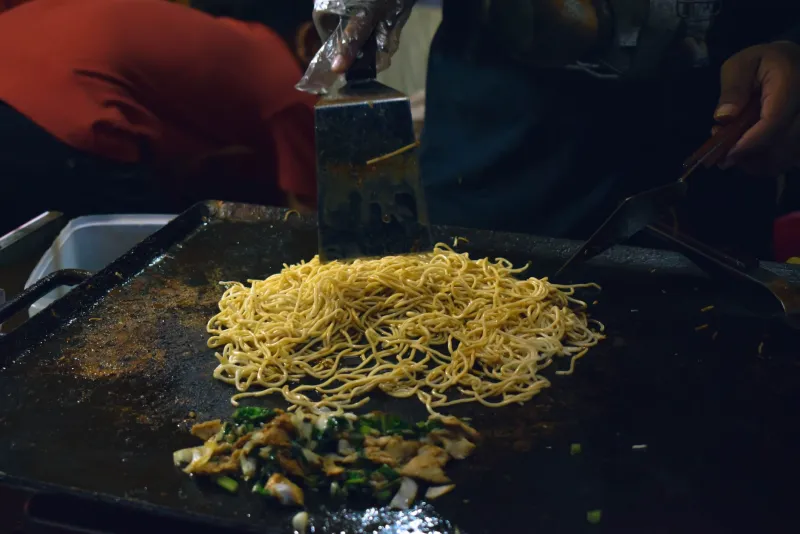
Hiroshima okonomiyaki usually includes a layer of yakisoba. On a backyard griddle, I par-cook the noodles indoors or on the low zone before the party. At service, I portion them into loose nests, warm them on the low zone, and season them lightly with okonomiyaki sauce or a splash of Worcestershire. They should be hot and a little crisp at the edges, not drowned.
Eggs are the final move. Crack one onto the hot zone, break the yolk gently, and let it spread into a thin sheet. Slide the okonomiyaki on top of the egg, then flip the whole thing so the egg is on the outside. Give it 30 seconds on the hot zone for color, then move it to the low zone. Sauce it at the rail, not on the cooking surface, so the sauce does not burn and gum up your griddle.
Wind, cold, and the propane curve
A backyard griddle is a fair-weather friend until you learn its weaknesses. Wind is the big one. It steals heat, pushes flames, and makes a hot zone feel unpredictable. Set up a wind break if you can: a patio wall, a couple of heavy cutting boards, or a foil baffle around the back and sides. Never block the air intake or vents. If the wind is gusting, cook in smaller batches and keep a lid or a metal dome nearby to trap heat over the medium zone.
Cold weather changes the rhythm, too. In November, a propane tank can feel half empty even when it is not. Keep a spare tank on hand, and do not run the griddle on a low tank in cold air. Bring the batter to room temperature, keep the cabbage in a cooler but drain it well, and preheat a few minutes longer. Cold ingredients on a cold griddle will steam instead of sear.
A batch plan for a backyard crowd
For eight to ten people, I plan on one large okonomiyaki per person, plus a couple of extras. That sounds like a lot of last-minute cooking, but the zones make it manageable.
- Before guests arrive: shred cabbage, slice pork, make batter, cook noodles, set out sauce and garnishes. Preheat the griddle.
- First wave: cook four stacks on the hot and medium zones. Finish with egg, sauce, and toppings. Send them to the table.
- Second wave: while people eat, start the next four. Use the low zone to hold finished stacks for no more than five minutes; longer than that and the crisp edge goes soft.
- Last call: cook two or three smaller stacks for seconds. This is also the moment to throw on extra noodles or a few pork slices for anyone who wants a bun-less plate.
Do not try to cook twelve okonomiyaki at once. A crowded griddle drops in temperature, the cabbage releases water, and you end up steaming everything. Smaller waves give you better edges and a calmer party.
The finish is part of the station
Keep the sauce, mayonnaise, aonori, and bonito at a separate finishing rail. Squeeze sauce in stripes, not a flood. Add mayonnaise in a thin zigzag if you like it. Scatter aonori and bonito just before serving. The bonito will move in the heat; that is the point.
A backyard Blackstone will never be a Hiroshima teppan, but it does not need to be. It gives you width, heat control, and a reason to move the party outside. Treat the burners as zones, keep the stacks moving, and protect the crisp edge. The burgers can wait until next weekend.